Those dark streaks running down your roof aren't dirt, and they're not going away on their own. They're a living organism called Gloeocapsa magma — and it's eating your shingles. We eliminate it with a roof-safe, gentle cleaning system. Guaranteed results for 3 years.
If your roof has dark streaks running vertically down the slope, you're looking at Gloeocapsa magma — a cyanobacterium (blue-green algae) that feeds on the crushed limestone filler used in asphalt shingles. It's not dirt. It's not mold. It's not tree sap. It's a living organism, and it's been spreading across roofs in Central Ohio at an accelerating rate.
Ohio's combination of high humidity, warm summers, and frequent rain creates the perfect environment for Gloeocapsa magma to thrive. The organism produces a dark, pigmented sheath to protect itself from UV radiation — that's the black color you see. As the colony grows, it spreads in streaks that follow the path of rainwater down your roof.
Here's what most homeowners don't realize: the algae isn't just sitting on your shingles — it's feeding on them. It breaks down the limestone filler that gives shingles their weight and structure, gradually thinning the protective granule layer. As granules erode, your shingles lose their UV protection, become brittle, and fail years before they should.
We respond within minutes. Free drone assessment included.
We fly a drone over your roof to photograph every section, mapping the extent of algae coverage and identifying any other issues. You receive the drone photos and a detailed estimate by email — no one climbs on your roof, no obligation.
Working from ladders only, we apply our biodegradable algaecide solution across your entire roof surface. The solution penetrates the Gloeocapsa magma colony and destroys it at the cellular level — killing the bio-cells that produce the dark pigment. No pressure washing. No one walks on your roof. No granule damage.
The algae begin dying immediately. By the time our team packs up and gets ready to leave, your roof is transformed and looking its best. We fly the drone again to document the results and provide before-and-after photos. Your 3-Year Bio-Free Guarantee starts the day we finish.
Many homeowners are told they need a new roof when what they actually need is a cleaning. If your roof has black streaks but no missing shingles, no active leaks, and was installed within the last 20 years — treatment may be the right answer, but the roof's condition should be assessed first.
Not sure which one you need? Our free drone assessment will show you exactly what's on your roof — algae or actual damage.
Central Ohio is one of the worst regions in the country for roof algae. Here's why:
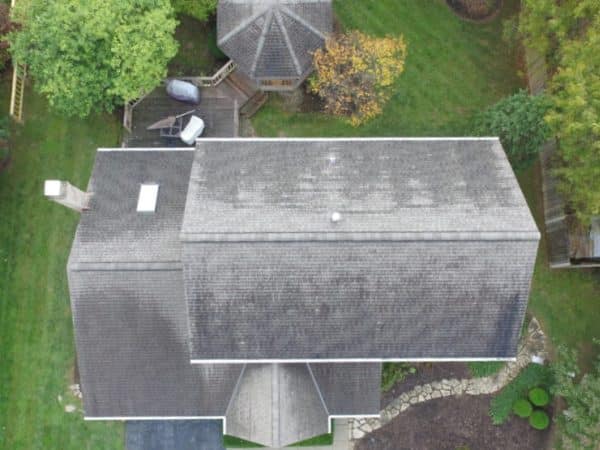
Typical black streak pattern on a Columbus-area shingle roof — before treatment
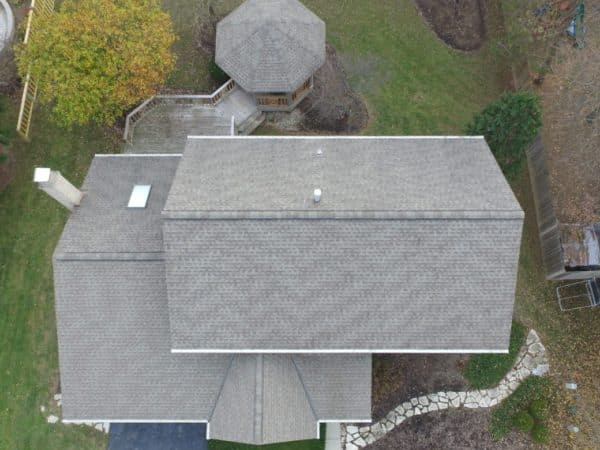
See the difference when algae is properly treated — not pressure washed off, but killed at the cellular level.
Gloeocapsa magma algae completely eliminated with our no-pressure, roof manufacturer-approved treatment.
"This is a well-run and needed company. Our roof is in the midlife phase. There were two or three mossy areas and some darker streaks. They used a drone to identify the needs of the roof. The moss is now truly dying out and the roof looks like a new one. Job well done!"
"Dwayne was very professional and responsive. The black streaks on our shingles are completely gone. He explained exactly what he was doing and why, and the quality commitment gave us total peace of mind. Highly recommend Forza to any Columbus homeowner."
"We had terrible black streaks covering our entire north-facing roof. Forza came out with their drone, showed us exactly what was going on, and cleaned the whole thing in one day. It looks brand new — like we got a new roof. The 3-year guarantee sealed the deal for us. Highly recommend!"
Black streaks are caused by Gloeocapsa magma, a cyanobacterium that grows on the crushed limestone filler in asphalt shingles. It produces a dark pigmented sheath to protect itself from UV radiation — that's the black color you see. It's not dirt, mold, or tree sap. It's a living organism that spreads across your roof over time.
Yes. The algae feed on the limestone in your shingles, gradually breaking down the granule layer that protects against UV damage. As the protective layer thins, shingles become brittle, crack, and fail prematurely. Left untreated, algae can reduce your roof's lifespan by 5-10 years. Read our detailed breakdown.
No — and doing so will cause more damage than the algae. Pressure washing physically blasts away the protective granule layer on your shingles and can affect manufacturer warranty coverage. ARMA warns against pressure washing and recommends a non-pressure chemical treatment approach. See what manufacturers actually say.
Black streak removal in Columbus typically ranges from $600 to $1,600+ depending on roof size and pitch. Compare that to a roof replacement at $8,000–$20,000+ — treatment is a fraction of the cost. See our full pricing guide.
The algae begin dying immediately upon treatment. Homeowners see dramatic transformations by the time we leave. After treatment, the algae will be gone. Moss and lichen will be dead, but they may remain rooted around the granules. Forcing the dead growth off can pull granules from your roof. The gentlest approach is to let it dry and flake away through several sun-and-rain cycles. Before long, it will be gone without damaging the roof. Our 3-Year Bio-Free Guarantee covers you if streaks return.
Black streaks alone do not prove that a roof needs replacement. The roof's age, condition, leaks, and shingle damage all matter. Our free drone assessment will show you what's visible on your roof — algae or signs of actual damage — so you can make an informed decision. Read: Could cleaning save you $15,000?
In-depth articles from our team about what's on your roof and how to deal with it.
Get a free drone assessment and no-obligation estimate. We serve Columbus, Dublin, Westerville, Powell, and all of Central Ohio.
Not sure what's on your roof?
Take Our Free Diagnosis Quiz →